When we talk about road construction, we often focus on the grand machinery—the pavers, the rollers, the graders. Yet, the most critical challenge is often invisible: the relentless, unimpeded flow of concrete. Traditional models, reliant on stationary concrete batch plants and a fleet of transit mixers, inject a multitude of risks into this vital flow. Delays, material inconsistency, and exorbitant logistics costs become built-in inefficiencies. There is a more thoughtful, more efficient path forward. Integrating portable concrete plants directly into the road construction corridor isn’t just an equipment choice; it’s a fundamental re-engineering of the supply chain that places the project’s needs first. This approach directly addresses the core vulnerabilities of road building, transforming concrete from a logistical headache into a dependable, controlled asset.
## Demolishing the Distance Dilemma: The Proximity Advantage
The greatest thief of efficiency in traditional road construction is distance. Every kilometer between a stationary batch plant and the paving front represents a cascade of potential problems. Concrete has a strict biological clock, a limited window of workability before it begins to set. Long hauls gamble with this science, risking slump loss, cold joints, and compromised final strength. More than that, they create a brittle, traffic-dependent supply line vulnerable to the unexpected—a single accident or road closure can halt an entire paving operation.
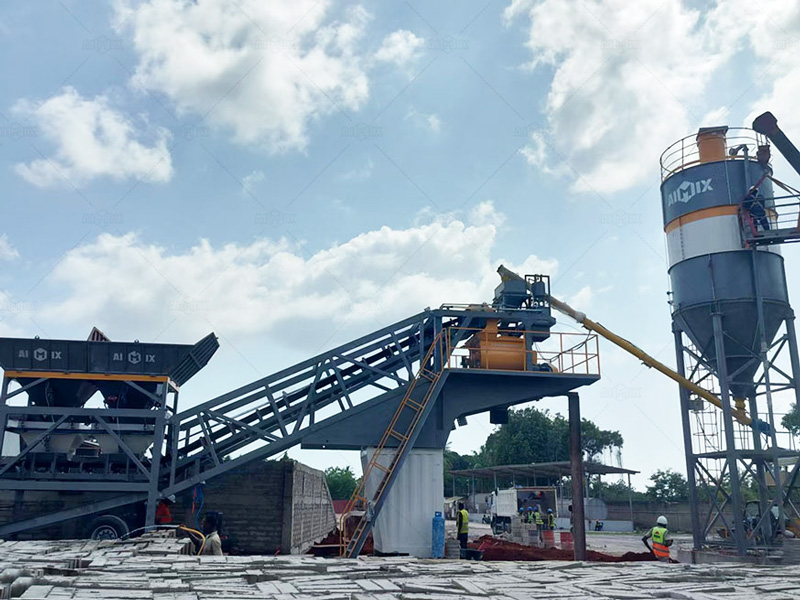
Portable concrete plants dismantle this dilemma entirely. By deploying a production facility directly adjacent to the work zone, we effectively eliminate transit time. This proximity is transformative. It allows for the precise synchronization of concrete production with the paving machine's forward crawl. The supply rhythm is no longer dictated by truck rotation schedules and traffic reports, but by the project's own operational tempo. Fresh concrete is delivered in a consistent, predictable stream, its quality and workability perfectly preserved. This isn't merely a time-saver; it is a fundamental guardrail for quality, ensuring every cubic meter placed is in its optimal state, leading to a more uniform, durable road surface from the very first pour.
## Reclaiming Control: The End of Supply Chain Vulnerability
Outsourcing concrete production surrenders control over two of a project's most sensitive nerves: cost and consistency. You become subject to the supplier's pricing fluctuations for fuel and materials, and to their operational delays. This external dependency is a persistent source of budget anxiety and scheduling uncertainty. A [portable concrete plant for sale](https://aimixconcretesolution.com/concrete-batching-plant/portable/) represents a powerful act of reclamation.
By bringing production in-house, the project team insulates itself from exogenous cost volatility. You secure bulk aggregates and cement, locking in major material costs and buffering against sudden market shifts. More importantly, you gain absolute command over mix design and quality at the point of creation. Need to adjust for the day's heat or humidity? It's an immediate decision, not a phone call fraught with delay. This mastery over material consistency ensures that the concrete for Kilometer 22 has the exact same properties as the concrete from Kilometer 1, guaranteeing structural homogeneity throughout the entire roadway. This level of direct oversight is the very foundation of engineering integrity and long-term infrastructure resilience.

## The Flexibility Dividend: Adapting to the Terrain of the Project
Road construction is a linear conquest of geography, and a portable plant is the ideal companion for this journey. Unlike a fixed facility, it is designed for mobility and adaptation. For a multi-phase project stretching across dozens of kilometers, the plant can leapfrog ahead, setting up a new production hub for the next segment with minimal downtime. This phased deployment keeps the supply chain taut and efficient, avoiding the diminishing returns of ever-longer haul distances from a single, static point.
Furthermore, this mobility offers a profound benefit often overlooked: the reduction of community and environmental burden. A stationary plant requires hundreds of heavy truck journeys through public roads, contributing to noise, dust, congestion, and wear on municipal infrastructure. A [small concrete batch plant for sale](https://aimixconcretesolution.com/concrete-batching-plant/small/) stationed directly on the construction right-of-way contains this impact. It localizes the activity, dramatically reducing truck traffic on public thoroughfares. This is a more considerate, sustainable approach that respects the communities surrounding the project and minimizes the overall environmental footprint of the construction process. It demonstrates that true efficiency isn't just about speed—it's about building intelligently, with respect for both the project's needs and its context.
In essence, choosing a portable concrete plant for road construction is a decision to prioritize certainty over chance, control over contingency, and smart integration over wasteful logistics. It is the recognition that the most efficient way to build a reliable road is to start with a reliable, self-determined foundation for the concrete that forms its very bones. This method protects your schedule, your budget, your quality standards, and the public trust, paving the way forward in every sense of the word.

Comments
No comments yet. Be the first to react!