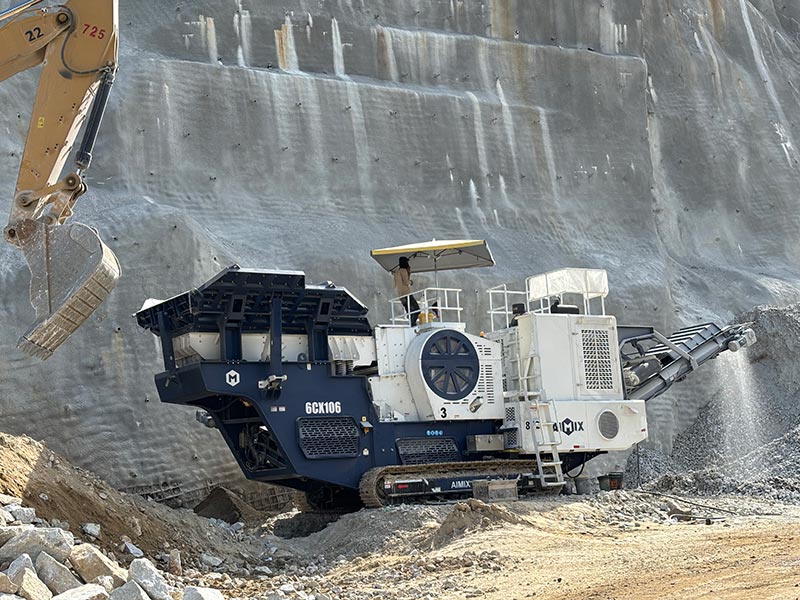
Granite stands as a monument to terrestrial endurance, a plutonic igneous rock forged under immense heat and pressure within the earth’s crust. Its very name evokes solidity and permanence, qualities derived from a dense interlocking matrix of quartz, feldspar, and mica. This geological fortitude, while prized for construction and monuments, presents a singular and formidable challenge for aggregate production. Processing granite is not a task for marginal machinery; it is an abrasive, high-impact endeavor that will swiftly degrade equipment not purpose-built for the ordeal. Within this context, the tracked mobile jaw crusher for sale emerges not as a mere option, but as the quintessential solution. It represents a synthesis of brutal mechanical force, resilient material science, and strategic mobility, engineered explicitly to subdue the most intractable stone and transform it into valuable, specification-grade aggregate.
The Granite Imperative: A Material That Demands Respect
To understand the necessity of specialized equipment, one must first appreciate the adversary. Granite’s compressive strength is exceptional, often exceeding 200 MPa. Its Mohs hardness, particularly imparted by its quartz content, subjects crushing surfaces to a continuous, sandpaper-like abrasion. This combination of high strength and high abrasiveness creates a dual-aspect wear mechanism: crushing components must withstand tremendous cyclical impact forces without fracturing, while simultaneously resisting the gradual, erosive scouring that dulls edges and diminishes efficiency. Conventional crushers or those designed for softer materials like limestone are rapidly overwhelmed. They incur catastrophic wear part failure, produce excessive and inconsistent fines, and suffer from debilitating downtime. The economic model for processing granite disintegrates when machinery must be stopped daily for component replacement or repairs. Thus, the selection of a primary crusher becomes the foundational decision upon which the entire profitability of the operation rests.

The Anatomy of a Track Jaw Crusher: Engineered for Conquest
The track jaw crusher is a masterpiece of focused engineering, each element addressing the granite challenge. At its heart lies the crushing chamber, defined by a fixed jaw and a reciprocating movable jaw. The kinematics of this system are critical. An elliptical motion, often achieved through a robust eccentric shaft, applies both vertical and horizontal force vectors to the feed material. This action creates a compelling “chewing” motion, first gripping the granite boulder and then applying a combination of compression and attrition to induce fracture along natural cleavage lines. The jaw plates themselves are cast from manganese steel or similar alloys, engineered to work-harden under impact, creating a surface that becomes more resistant over time. The chamber geometry is precisely calculated to ensure optimal nip angle—the angle between the jaws—which must be acute enough to grip the rock effectively but not so steep as to cause slippage or chamber clogging.
This formidable crushing mechanism is integrated onto a track-mounted chassis, a feature that confers a decisive strategic advantage. The crawler tracks provide a stable, low-ground-pressure platform that allows the entire unit to traverse rough, uneven quarry floors or demolition sites without the need for costly and time-consuming pad construction. Hydraulic drive systems enable the mobile crusher plant to be positioned with pinpoint accuracy, often directly at the quarry face or beside a pile of demolition granite. This mobility eliminates the primary bottleneck of fixed-plant operations: the reliance on dump trucks for primary feed transport. The machine moves to the rock, slashing cycle times, reducing fuel consumption across the fleet, and dramatically shrinking the operational footprint.
Operational Dominance in Granite Quarrying and Recycling
In application, the track jaw crusher demonstrates its preeminence through measurable outcomes. Its reduction ratio—the difference between feed size and product size—is profoundly high in a single pass, capable of transforming meter-scale boulders into manageable, conveyable fragments in seconds. This efficiency cascades through the downstream process, alleviating load on secondary crushers and screening plants. Furthermore, the adjustability of the jaw gap, often via hydraulic toggle systems, allows for real-time control over product sizing. An operator can produce a coarse rip-rap product for erosion control in one instance, and then adjust to create a base course aggregate meeting strict gradation specifications in the next, all with the same machine.
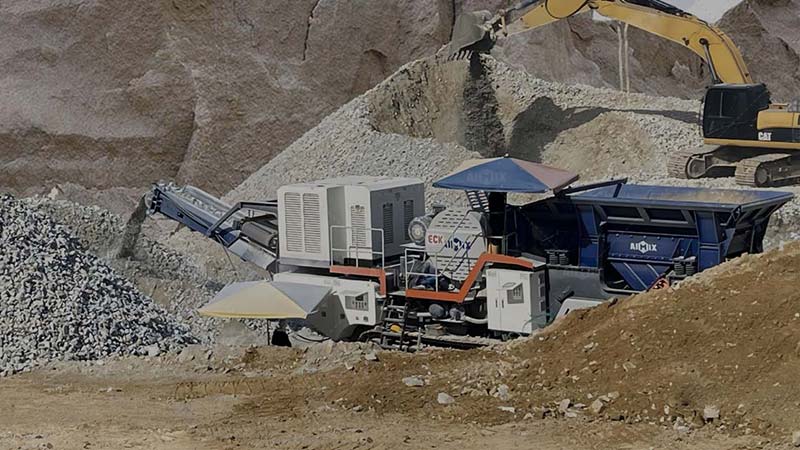
Durability is the crusher’s defining characteristic in the granite environment. Every component, from the reinforced frame that resists bending moments to the spherical roller bearings that manage radial and thrust loads, is oversized and over-engineered for this specific duty cycle. Labyrinth seals and centralized grease lubrication systems protect critical pivots from the insidious ingress of granite dust, a primary agent of premature bearing failure. The sustained performance in this abrasive milieu translates directly to higher availability, the most crucial metric in heavy equipment economics. Where lesser machines falter, the purpose-built track crusher maintains its operational tempo, delivering consistent tonnage hour after hour.
The Calculated Return on a Formidable Investment
The acquisition cost of a premium track jaw crusher is substantial, a fact that demands a holistic valuation. The analysis must transcend mere purchase price and embrace the concept of total operational cost. This calculation factors in the cost-per-ton metric, which incorporates fuel efficiency, wear part consumption, maintenance labor, and, most significantly, machine availability. A robust jaw crusher, through its superior durability and reduced unplanned downtime, achieves a lower cost-per-ton over its lifespan, despite a higher initial outlay. It is an investment in predictable production, safeguarding project timelines and contractual commitments.
Moreover, this class of equipment future-proofs an operation. Its mobility allows a single unit to service multiple quarry faces, transition to a new site entirely, or pivot to processing large-scale granite demolition waste from urban renewal projects. This adaptability protects the investment against the depletion of a single resource or shifts in market demand. The track jaw crusher, therefore, is not just a tool for breaking granite; it is a strategic asset. It is the definitive answer to a material that tolerates no compromise, enabling operators to harness the enduring strength of granite and build upon a foundation of mechanical certainty.

Comments
No comments yet. Be the first to react!